
How to Find Recently Released Brevard County Inmates
Brevard County release data lives in the same jail roster used to find people in custody. The Brevard County Sheriff's Office runs the BCSO inmate search, and the results table includes a Released column with a Yes or No flag for each booking. A booking detail page lists the booking date, the release status, and a booking history with an "In Custody" badge when the person is still being held.
The BCSO data is a courtesy. Inmate data changes fast, and for a release that happened in the last few hours, the roster may still show the person as in custody. A short phone call to the jail closes that gap. For a release tied to state prison, the trail moves out of BCSO and into the Florida Department of Corrections.
- Open the BCSO inmate search portal and enter the last name, first name, or a date range that covers the booking.
- Read the Released column in the results table. Yes means the person has been released, No means still in custody at the time of the data pull.
- Click the booking number to open the detail page, then check Booking Information for the release line and Booking History for the current status badge.
- For a release that is hours old, follow up by phone with Inmate Information at the jail to confirm.
- For a release into state custody, move the search over to the FDC offender search.
Setting Up Brevard County Release Alerts on VINELink
VINELink is the statewide victim and public notification service for Florida. The Florida portal at vinelink.vineapps.com/state/FL covers county jails and state prisons across the state, Brevard included. A person who registers is contacted by phone, email, or text when an inmate's custody status changes. That covers releases, transfers, escapes, and in some cases court date updates. The service is free, and one account can track more than one offender.
The Florida portal pulls custody feeds from each county sheriff's office and the state DOC, so a Brevard booking and a later state prison transfer for the same person can be tracked from one account. Registration takes a few minutes. Search by name, pick the right record, then enter a phone number or email. Some delay between the release and the alert is normal, so pair it with a fresh check of the BCSO roster for time-sensitive use.
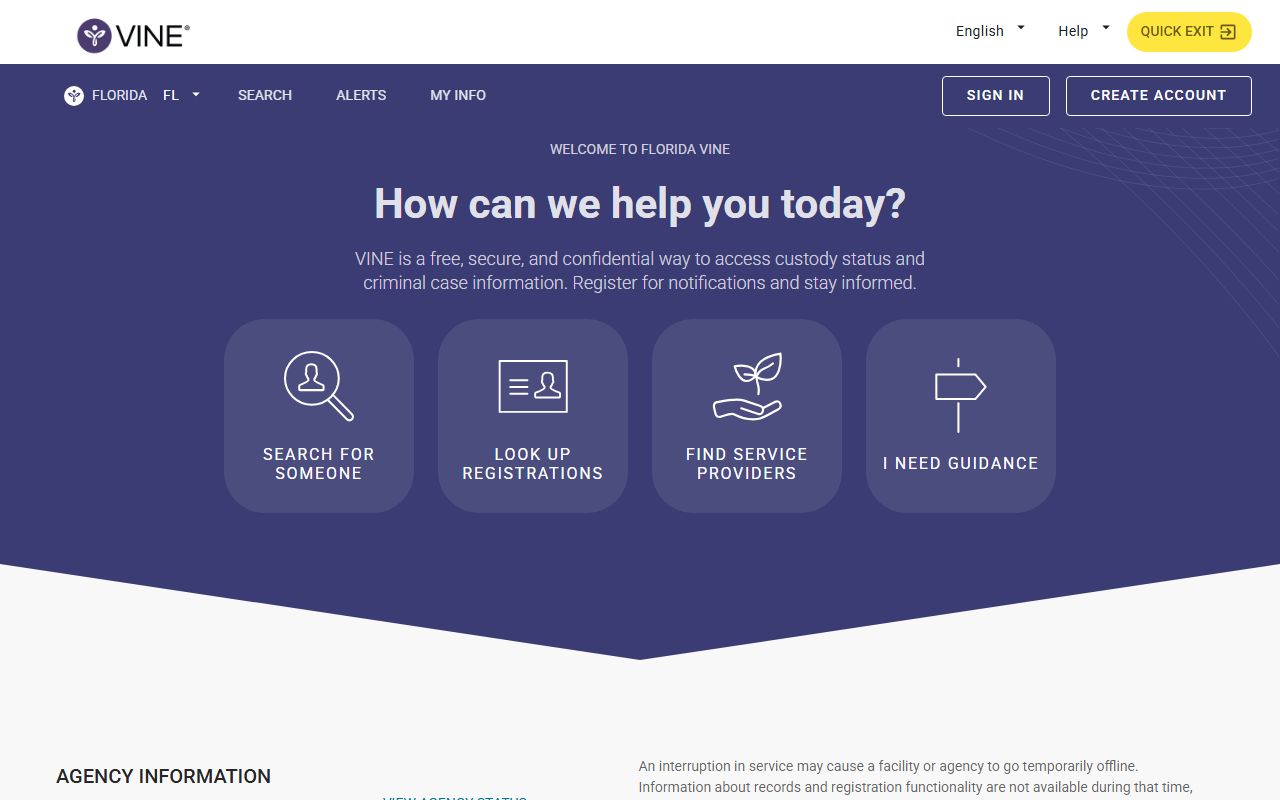
The portal is the same landing page used by victim services across Florida, and it is the route most county and state agencies point to for ongoing release alerts.
Searching State Prison Releases for Brevard County Through FDC
State prison release data sits with the Florida Department of Corrections, not the county jail. FDC runs an offender search menu at pubapps.fdc.myflorida.com that splits searches by type. One option is for current inmate population, one is for inmate release information, and one is for supervised offenders. FDC says release data is updated nightly, while inmate population data is refreshed weekly.
A Brevard case that ended with a state prison sentence will leave the BCSO jail and land in FDC. A person who shows as released on the BCSO roster may not be free at all. The FDC search uses the same core fields across the menu. Most people start with a last name, then narrow with a first name or a DC number. The image below comes from the official FDC inmate population search.
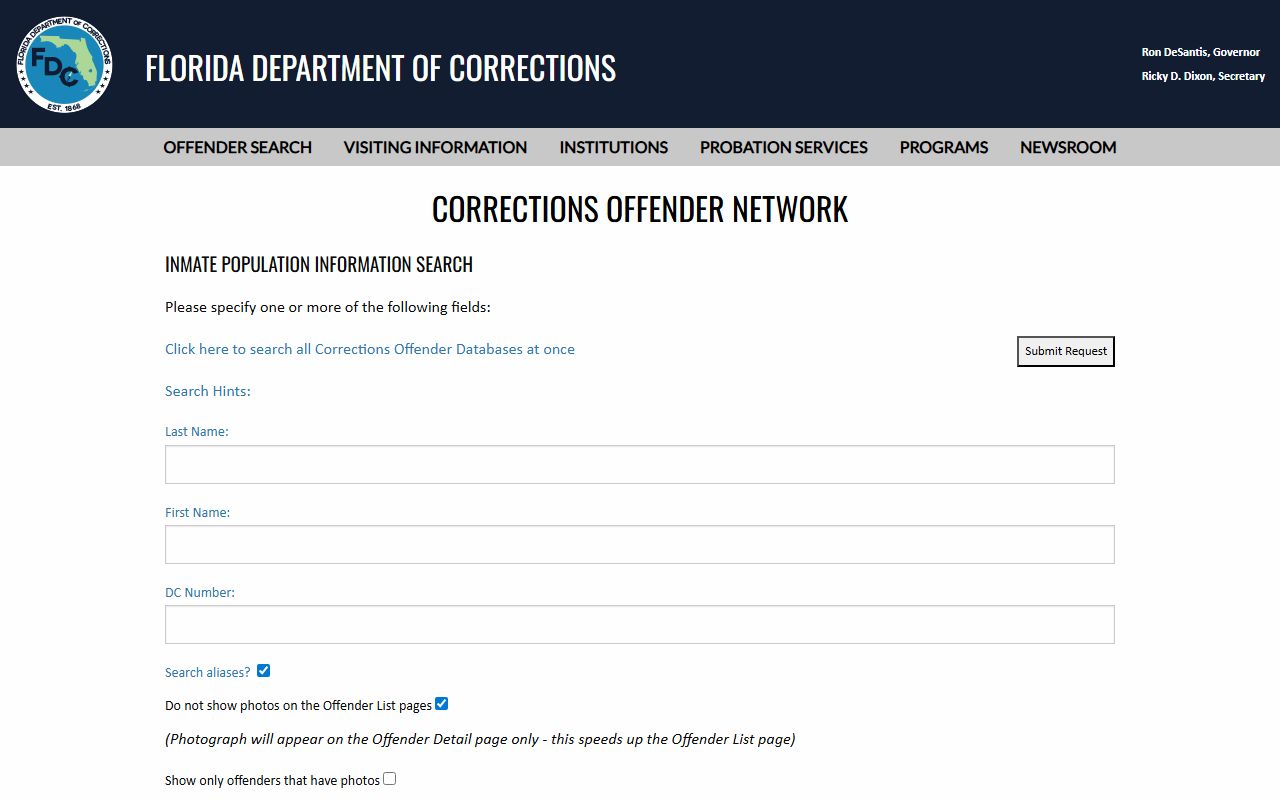
The same field set works for the release-information search, so the table below applies to both lookups.
| Field Label | Type | Required | Options / Format Notes |
|---|---|---|---|
| Last Name | Text | Optional | Max length 30. Returns matches beginning with entered letters. |
| First Name | Text | Optional | Max length 15. Returns matches beginning with entered letters. |
| DC Number | Text | Optional | Max length 6. FDC permanent ID number. |
| Search aliases? | Checkbox | Optional | Checked by default. |
| Do not show photos on Offender List pages | Checkbox | Optional | Checked by default. |
| Show only offenders that have photos | Checkbox | Optional | Unchecked by default. |
| Number of matches | Dropdown | Optional | 10, 15, 20 (selected), 25, 30, 35, 40, 45, 50. |
| Submit Request | Button | Yes | Top and bottom Submit buttons. |
| Clear Request | Button | Optional | Resets the form. |
The menu page also shows a second image of the full FDC offender search menu, which links to release, supervised, and absconder searches in one place.
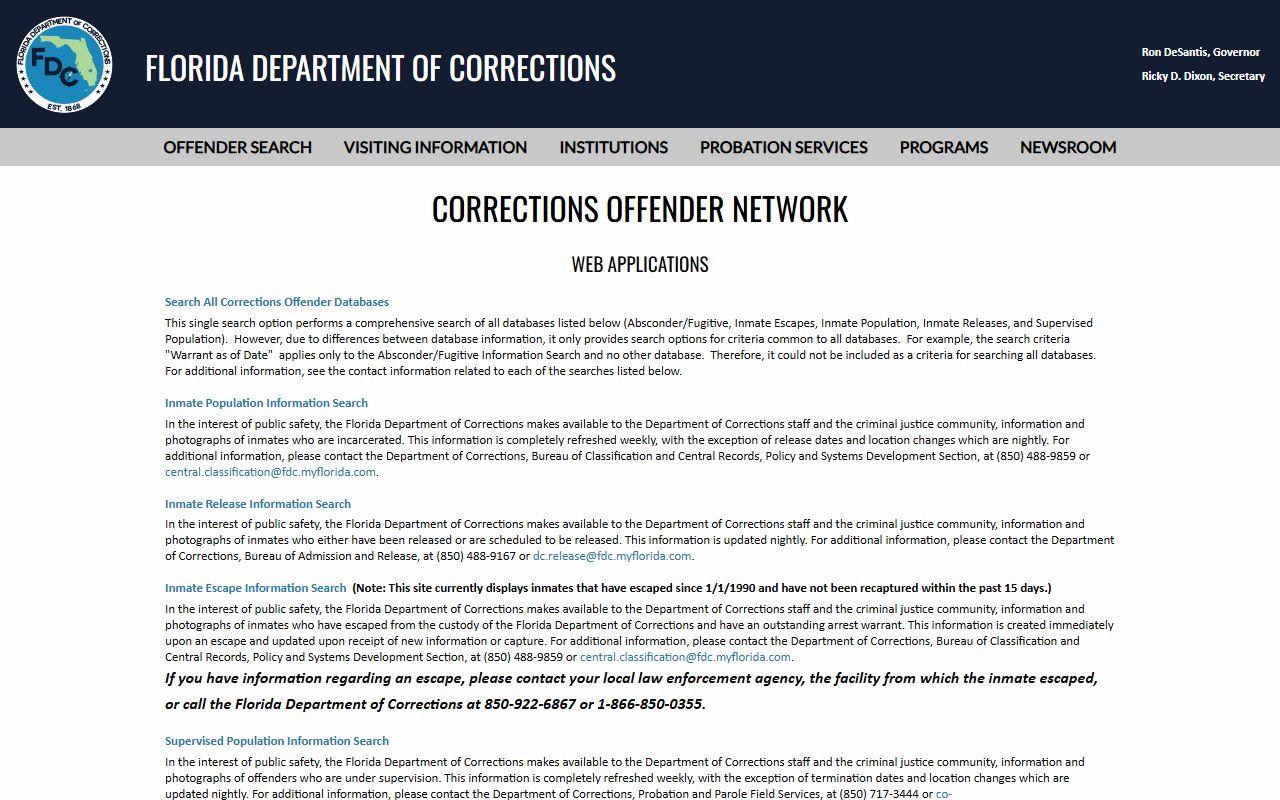
The menu is the right starting point when it is not clear whether the person is still in custody, on supervision, or already released.
Searching Federal Releases Tied to Brevard County Through the BOP
Federal cases follow a different track. A Brevard resident charged in the U.S. District Court for the Middle District of Florida will not show up in BCSO or FDC after sentencing. They will move into the federal Bureau of Prisons. The BOP inmate locator is the public tool for federal release lookups. It covers federal inmates from 1982 to today and shows the release date and current location.
The locator has two tabs. Find By Number searches by BOP Register Number, DCDC Number, FBI Number, or INS Number. Find By Name uses first, middle, and last name plus optional filters for race, age, and sex. Result fields shown on the page include name, register number, age, race, sex, release date, and location.
| Field Label | Type | Required | Options / Format Notes |
|---|---|---|---|
| Find By Number tab | Tab | Optional | Switches to number-based search. |
| Type of Number | Radio/Dropdown | Yes (number search) | BOP Register Number, DCDC Number, FBI Number, INS Number. |
| Number | Text | Yes (number search) | BOP Register Number shown as #####-###. |
| Find By Name tab | Tab | Optional | Switches to name-based search. |
| First | Text | Required | First name in the name search. |
| Middle | Text | Optional | Middle name filter. |
| Last | Text | Required | Last name in the name search. |
| Race | Dropdown/Radio | Optional | American Indian, Asian, Black, White. |
| Age | Text/Number | Optional | Age filter. |
| Sex | Radio | Optional | Male, Female. |
| Search | Button | Yes | Submits the form. |
| Clear Form | Button | Optional | Resets fields. |
Important. The BOP warns that the release date on a record may not be current. The First Step Act allows sentence recalculations that can move the release date by weeks or months. A status of "Released" or "Not in BOP Custody" only means the person is not in BOP custody. They may still be under federal supervised release, immigration custody, state custody, or local custody.
Combine the BOP search with the FDC release search and the BCSO roster for a full custody picture.
Verifying a Brevard County Release by Phone
Phone calls fill the gap between what the roster says and what is true right now. The BCSO Inmate Information and Bonds line is the same number used by family members to confirm a release, post bond, or get pickup instructions. Staff can pull up current custody status while on the call.
BCSO Inmate Records Unit
Brevard County Jail Complex
860 Camp Road
Cocoa, FL 32927
Inmate Records Unit: (321) 690-1546
Inmate Information / Bonds: (321) 690-1500 ext. 0
Main Reception: (321) 690-1500
The Inmate Records Unit at (321) 690-1546 is the right line for written record requests, certified booking records, and archived booking questions. Inmate Information at extension 0 handles day-to-day custody and bond questions. Both lines can confirm whether a release has been processed.
Warning. BCSO posts a clear disclaimer with its inmate search. The database is a courtesy. It is not a replacement for a formal F.S. 119 public records request. Data changes quickly and may contain errors. An arrest does not mean a conviction. The information should not be used for legal action, employment, credit, or housing decisions, and time-sensitive release checks should be confirmed by phone or by a direct records request.
The Florida Sex Offender and Predator Registry
Released sex offenders and predators are tracked apart from the general inmate locator. The FDLE Sexual Offenders and Predators Search is the public face of that system. Florida Statute 775.21, the Florida Sexual Predators Act, sets up the registry and the registration rules. People who fall under the statute keep a public record with FDLE long after their sentence ends, and the search tool covers Brevard along with the rest of the state.
The registry offers several search modes. An offender search uses first and last name. A neighborhood search uses address, city, ZIP, and a radius. A campus search covers postsecondary schools. An internet identifier search runs against email addresses and online handles. An alerts feature lets a user sign up for emails when a registered offender moves into a chosen ZIP code. The image below comes from the official FDLE sex offender registry homepage.
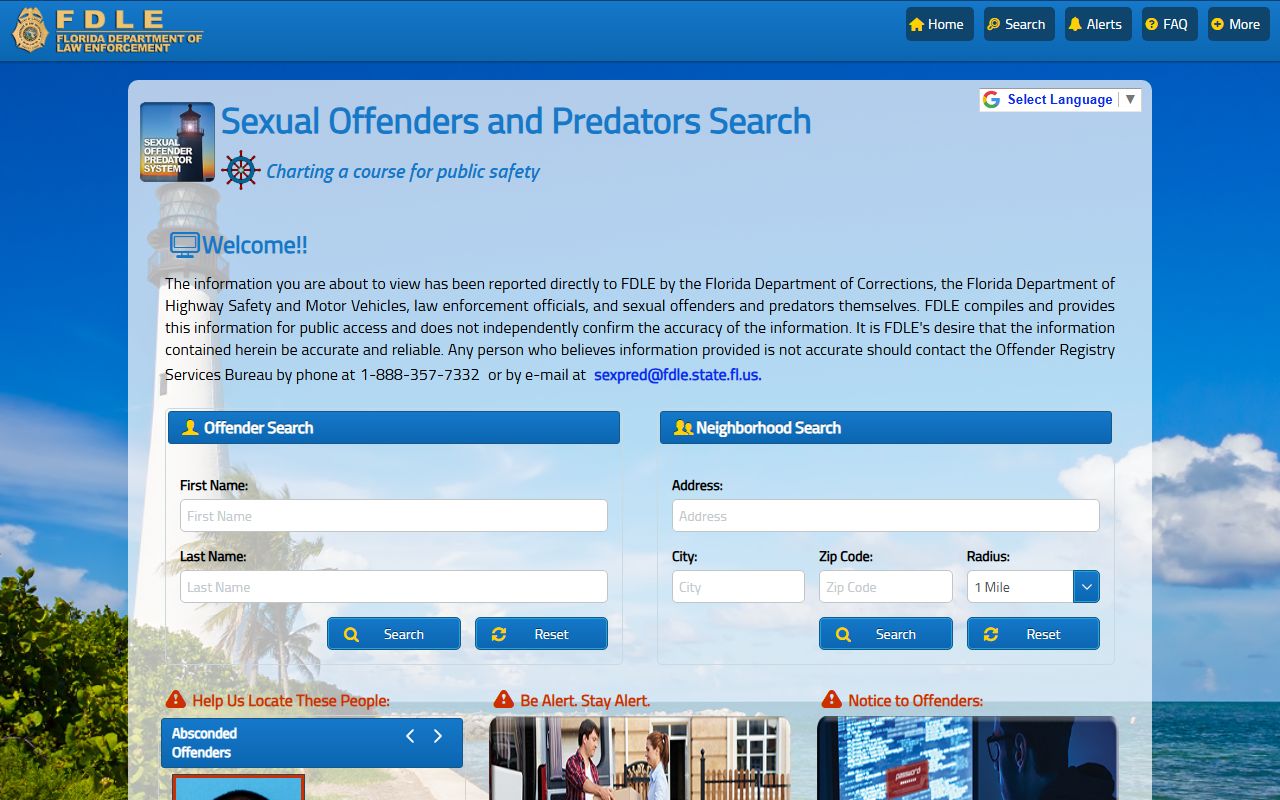
The FDLE page is the right starting point for any registered-offender lookup in Brevard, since the data feeds in from county, state, and federal partners.
| Search Mode | Inputs | What It Returns |
|---|---|---|
| Offender search | First name, last name | Match list with status, address, and offense data. |
| Neighborhood search | Address, city, ZIP, radius | All registered offenders within the chosen radius. |
| Campus search | School name or city | Registered offenders linked to postsecondary campuses. |
| Internet identifier search | Email address or online handle | Match to registered identifiers reported by offenders. |
| Offender alerts | Email plus chosen ZIP codes | Email notice when a registered offender moves nearby. |
FDLE notes that registry data is reported by FDC, the Department of Highway Safety and Motor Vehicles, law enforcement, and offenders themselves. FDLE compiles the records but does not independently confirm every fact. Note: a person released from a Florida prison may show in FDC, on the FDLE registry, and on VINELink at the same time, so all three sources should be checked together.
Parole and Probation Information in Florida
Florida ended parole for most felonies decades ago, but supervised release still exists in several forms. State probation, conditional release, and community control are run by FDC's Community Corrections arm. A Brevard defendant sentenced to state supervision reports to a probation officer assigned to the county, and the conditions become part of the FDC supervised-offender record.
The Brevard County Jail itself holds both pretrial detainees and sentenced county inmates, the people serving short jail terms after a misdemeanor or low-level felony. A release from that group does not mean the case is over. Many come with a probation tail, a license suspension, or court-ordered programs. Those conditions are tied to the case file at the Brevard Clerk and to the supervising probation office, not the jail roster.
For people on federal supervised release, the U.S. Probation Office for the Middle District of Florida handles the supervision side. The BOP locator will show the release date, but the supervised-release conditions live in the federal court docket on PACER.
Reentry Resources in Brevard County
Reentry after a release covers a lot of ground. Housing, jobs, treatment, family law, child support arrears, and license reinstatement all show up in the first few weeks. Brevard County Legal Aid is the main nonprofit on the civil side. Set up in 1970 by the Brevard County Bar Association, it works with a network of more than 400 volunteer attorneys. Its case mix covers family law, free foreclosure help, domestic violence, guardianship, consumer cases above small claims, bankruptcy where debt tops $10,000 with most of it medical, and landlord-tenant matters where the tenant is current on rent.
Brevard County Legal Aid
Serving Brevard County, Florida
Phone: (321) 631-2500
Legal Aid does not take criminal defense cases. The Public Defender for the Eighteenth Judicial Circuit handles those, but only after a court has appointed counsel and run a financial inquiry. Once a case ends and the client is released, the Public Defender's role ends too. Civil work after release falls to Legal Aid, private counsel, or pro se filings. The Eighteenth Circuit Public Defender homepage explains the appointment process.
Florida Bar Lawyer Referral Service
Statewide referral hotline used by the Brevard Clerk for probate and general lawyer referrals.
Phone: (800) 342-8011
The Florida Bar Lawyer Referral Service is the right call when a case falls outside Legal Aid's case types or income limits. The Bar matches the caller with a member attorney for an initial consult at a set fee.
Note: most reentry tasks have a tight clock, so calls to Legal Aid, the Bar Referral line, or a private attorney should start in the first week after release.
Civil Rights Restoration After a Brevard County Release
Florida treats civil rights restoration and record sealing as two different things. FDLE's seal and expunge page makes that point clearly. Restoration of civil rights can give back the right to vote, serve on a jury, and hold public office, but it does not automatically expunge a criminal history. The record stays in the state's hands even when rights have been restored.
FDLE goes further. A person adjudicated guilty of a felony that caused the loss of civil rights is not eligible for a standard seal or expunge solely because rights were later restored. The standard sealing and expunction process has its own conditions under Florida law. A withhold of adjudication, a dismissal, or an acquittal stand on different footing and may open the door to a seal or expunge.
The Florida clemency process governs the restoration of civil rights, and the current rules interact with court costs, restitution, and fines in ways that change case to case. A copy of the restoration order should be kept on hand for voter registration or jury service. For sealing or expunction, the petition runs through the Brevard Clerk. The Florida Sexual Predators Act, F.S. 775.21, is a reminder that some release classes stay on a public record after rights are restored.