
How to Search Brevard County Criminal Records
Most public searches start with two free tools. The Brevard Electronic Court Application, known as BECA, holds court files for felony, misdemeanor, and criminal traffic cases. The Brevard County Sheriff's Office runs a separate jail roster that tracks bookings and current custody. The court file shows pleadings, motions, orders, and dispositions. The jail roster shows who was booked, when, on what charges, and whether they were later released. Most users start with BECA when they have a case number or party name. They use the sheriff tool when they are looking for a recent arrest.
- Open the Clerk Case Search page and accept the BECA disclaimer to reach the General Public Court Records Search.
- Pick the right search type. Use party name for a person, or case number when you have one in the 05-YYYY-CF-###### format.
- Filter by case type. Pick CF for felony, MM for misdemeanor, or CT for criminal traffic. Try more than one spelling.
- Open the docket. Read the charge list, charging document type, plea, and judgment lines.
- For arrest data, run a second search at the BCSO inmate site at inmatesearch.brevardsheriff.org by name, booking number, or date range.
- If you need a certified record, file a public records request with the Clerk or the sheriff.
BECA is for court files only. It does not show in-jail status. The sheriff roster shows custody and booking detail, not full court history. Use both when you need a clear picture. The Clerk warns that online files are informational, not official, so a certified copy must be ordered when proof is needed in court. BCSO public records handles the sheriff side and lists a $2.00 records check fee per last-name inquiry.
The lead-in here goes to the BCSO public records page, which shows the request form, fee schedule, and payment options for arrest and case reports. View the BCSO public records request page.
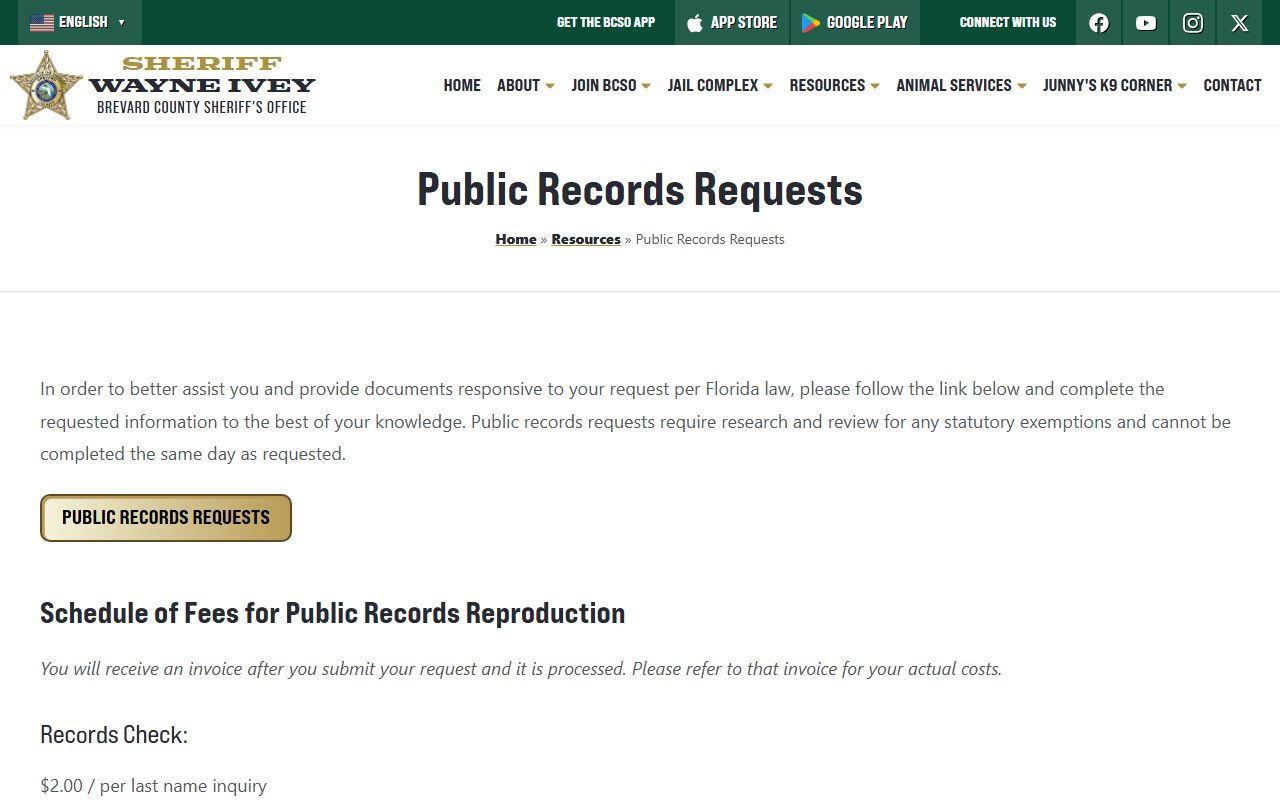
The screenshot above shows the BCSO request page, with the JustFOIA link, the per-page copy charge, and the note that personal checks are not accepted. That tool is the right path for sheriff-side arrest reports.
Arrest Records vs Brevard County Criminal Court Records
People often mix arrest records and court records, but they come from two different places. An arrest record is built by the arresting agency, like a sheriff or a city police force, at the moment of booking. A criminal court record begins later, when the State Attorney files a formal charge in the form of an information or grand jury indictment. The two files often share names and dates, but they hold different fields. Knowing which one you need saves time.
| Item | Arrest Record | Criminal Court Record |
|---|---|---|
| Source | Brevard County Sheriff's Office or city police | Clerk of the Circuit Court via BECA |
| Created When | At booking | When charges are filed in court |
| Main Fields | Booking number, charges, mugshot, bond | Pleadings, motions, orders, plea, judgment |
| Best Tool | BCSO inmate search | BECA Case Search |
| Custody Status | Shown | Not shown |
A full picture of a case in Brevard County criminal records often needs both. Pull the booking record for arrest detail. Then pull the matching court file for what happened next. For court-only research, see the full Brevard County court records page.
Charges vs Convictions in Brevard County Criminal Records
An arrest is not proof of guilt. A charge is not a conviction. Florida tracks each stage of a case as a separate event, and the file shows that path step by step. A person can be booked, charged, plead out, and still leave without a conviction on the record. The terms below come up in nearly every criminal docket.
| Item | Charge | Conviction |
|---|---|---|
| Stage of Case | Arrest, information, or indictment | Plea or jury verdict |
| Burden of Proof | Probable cause | Beyond a reasonable doubt |
| Filed By | State Attorney | Court of record |
| Withhold of Adjudication | Not yet decided | No formal conviction, court orders supervision |
| Public Record | Yes, unless sealed | Yes, unless sealed or expunged |
| Effect on Rights | None yet | May affect voting, firearms, jobs |
A Florida judge may also enter a withhold of adjudication. That keeps a person from being labeled a convicted felon for many state purposes, but the case file still shows the plea, the charge, and the sentence terms. A nolle prosequi means the State Attorney dropped the charge. A dismissed case can be dismissed with prejudice or without prejudice. Each tag has a different long-term effect.
What Brevard Criminal Court Records Show
A criminal court file in Brevard County is a mix of forms, orders, and docket entries. The Clerk pulls the same field set across felony, misdemeanor, and criminal traffic. Some images may be hidden under the Florida electronic access matrix or Rule 2.420. The table below is the standard public field set.
| Field | What It Shows |
|---|---|
| Case Number | Format 05-YYYY-CF-######-XXXX-XX for felony or 05-YYYY-MM-###### for misdemeanor |
| Party Names | State of Florida vs Defendant |
| Filing Date | Date the State Attorney filed the charging document |
| Case Status | Active, disposed, sealed, reopened, or stayed |
| Division | Criminal felony, criminal misdemeanor, criminal traffic |
| Charges | Statute cite, charge text, count, degree |
| Docket Entries | Motions, hearings, orders, sentence events |
| Bond | Bond type, amount, posting agent, release date |
| Disposition | Plea, verdict, dismissal, nolle prosequi, withhold |
| Sentence | Jail, prison, probation, fines, costs, restitution |
Some fields are redacted by rule. Social Security numbers, bank or card data, victim identifiers in sex-crime cases, and family or juvenile detail are stripped under F.S. 119.071 and F.S. 119.0714. Certified copies still show the public fields. Restricted images may need a subscriber log-in under F.S. 28.2221.
The Office of the State Attorney, 18th Judicial Circuit
Every criminal case in Brevard County moves through the State Attorney's office before it ever reaches a jury. The State Attorney decides whether to file an information, take the case to the grand jury, divert it, or drop it. The same office prosecutes the case, talks with victims, and handles plea offers. Brevard sits in the 18th Judicial Circuit along with Seminole County. The current State Attorney is William Scheiner, a career prosecutor who was elected in 2024 after years as chief trial attorney for the county.
Office of the State Attorney, 18th Judicial Circuit
William Scheiner, State Attorney
2725 Judge Fran Jamieson Way, Building D
Viera, FL 32940
Phone: (321) 617-7510
Web: sa18.org
The State Attorney site lists pages for public records requests, victim resources, defense resources, and media contact. Victims who want case status, restitution help, or notice of court dates can reach the victim advocate unit through that same office. Defense counsel and self-represented parties can request discovery and case files through the records page.
Mugshots, Bookings, and Brevard County Arrest Records
Mugshots and booking sheets come from the sheriff, not the court. In Brevard County, the Brevard County Sheriff's Office takes the booking photo when a person is brought into the Brevard County Jail Complex at 860 Camp Road in Cocoa. That photo and the booking detail post to the BCSO inmate search. The roster shows the booking number, name, date of birth, charges, bond, and a yes or no flag for release. The sheriff warns that data may change fast and that an arrest is not proof of guilt.
For a deeper look at jail status, custody changes, or a list of current inmates, use the Brevard County inmate records page. For people who have already left custody, go to the released inmates page. For active warrants tied to a booking, see Brevard County warrant records. The jail roster does not show full court history, so always pair it with a BECA search by name or case number.
Mugshots posted on private mugshot sites are not part of the official record. They are copies. The only confirmed Brevard arrest photo is the one held by BCSO. Some sealed or expunged cases lose the photo from public view under F.S. 943.0585 or F.S. 943.059, even though private sites may still show old copies.
Florida Statutes Governing Criminal History
Florida sets the public access rules for criminal history by statute. The Florida Department of Law Enforcement, known as FDLE, holds the state criminal history file. Court records sit with the Clerk of the Circuit Court. Each office answers to a different chapter of Florida law. The five statutes below come up most often in Brevard County criminal records work.
Key Florida Statutes
- F.S. 943.053: Dissemination of criminal justice information. Sets the rule for who can get adult criminal history.
- F.S. 943.0585: Court-ordered expunction. Lays out who can ask a judge to wipe a record.
- F.S. 943.059: Court-ordered sealing. Hides a record from the public while certain agencies keep access.
- F.S. 119.0714: Court files, court records, and official records. Controls redaction of personal data in clerk files.
- F.S. 775.21: Florida Sexual Predators Act. Sets the rules for registry and public notice.
The screenshot below is from the official Florida Senate site for F.S. 943.053, the dissemination statute that controls how police agencies and the public can pull adult criminal history. Read F.S. 943.053 on the Florida Senate site.
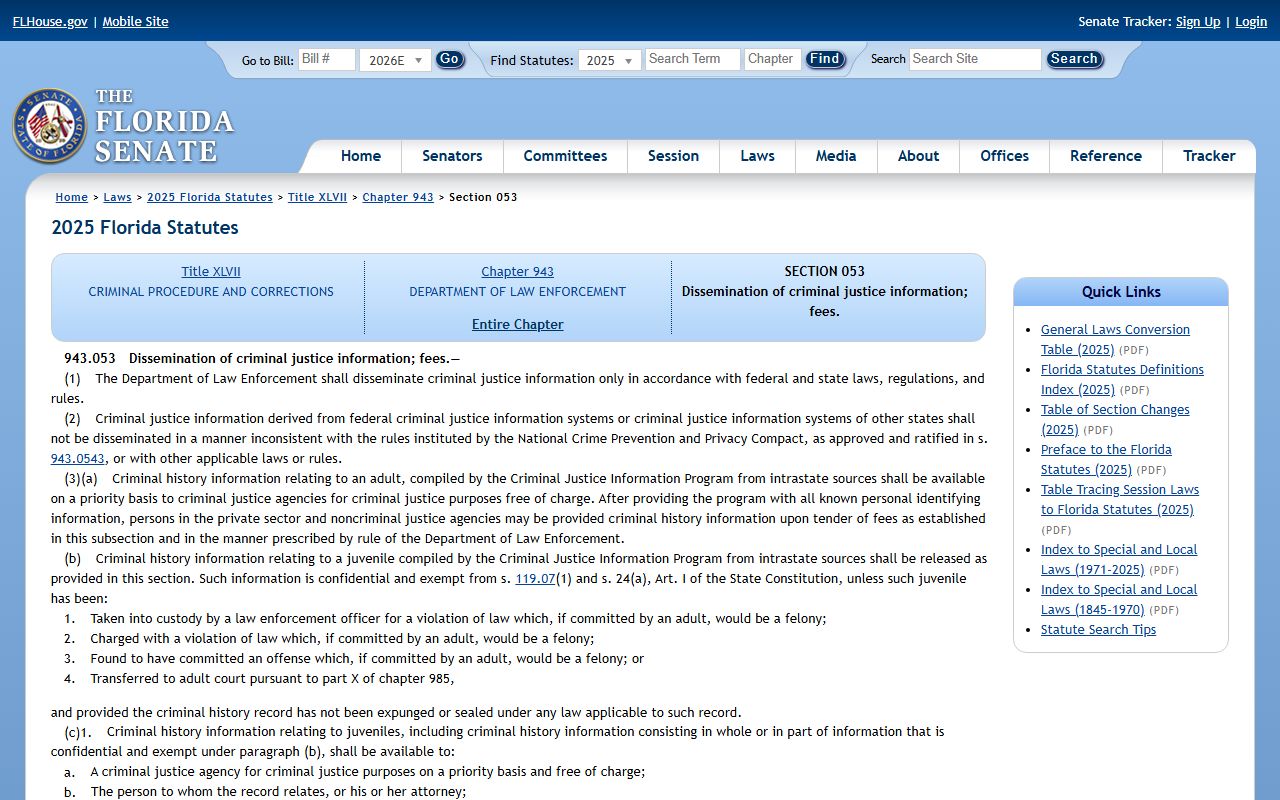
The page shown sets the legal floor for criminal history release in Brevard and every other Florida county, with some exemptions for juveniles and sealed cases.
Sealed vs Expunged Brevard County Criminal Records
Sealing and expunging both hide a criminal record, but the effect is not the same. Sealing keeps the file in the clerk's vault and lets some agencies look at it. Expunging goes further and orders the file destroyed for most purposes. Florida law treats them as two paths under two statutes, with different eligibility rules.
| Item | Sealed | Expunged |
|---|---|---|
| Statute | F.S. 943.059 | F.S. 943.0585 |
| Public Access | Hidden from public view | Treated as if it never existed |
| Agency Access | Courts, FDLE, and some employers keep limited access | Very narrow access by court order only |
| What Records Get It | No conviction, but some plea or finding occurred | Charge was dropped, dismissed, or never filed |
| Who Can Get One | Person with no prior conviction and no current adjudication | Person whose case ended without adjudication |
| Number Allowed | One in a lifetime under standard process | One in a lifetime under standard process |
People often try sealing first when an expunction is not an option. The screenshot of F.S. 943.059 on the Florida Senate page is shown below. Open F.S. 943.059 on the Florida Senate site.
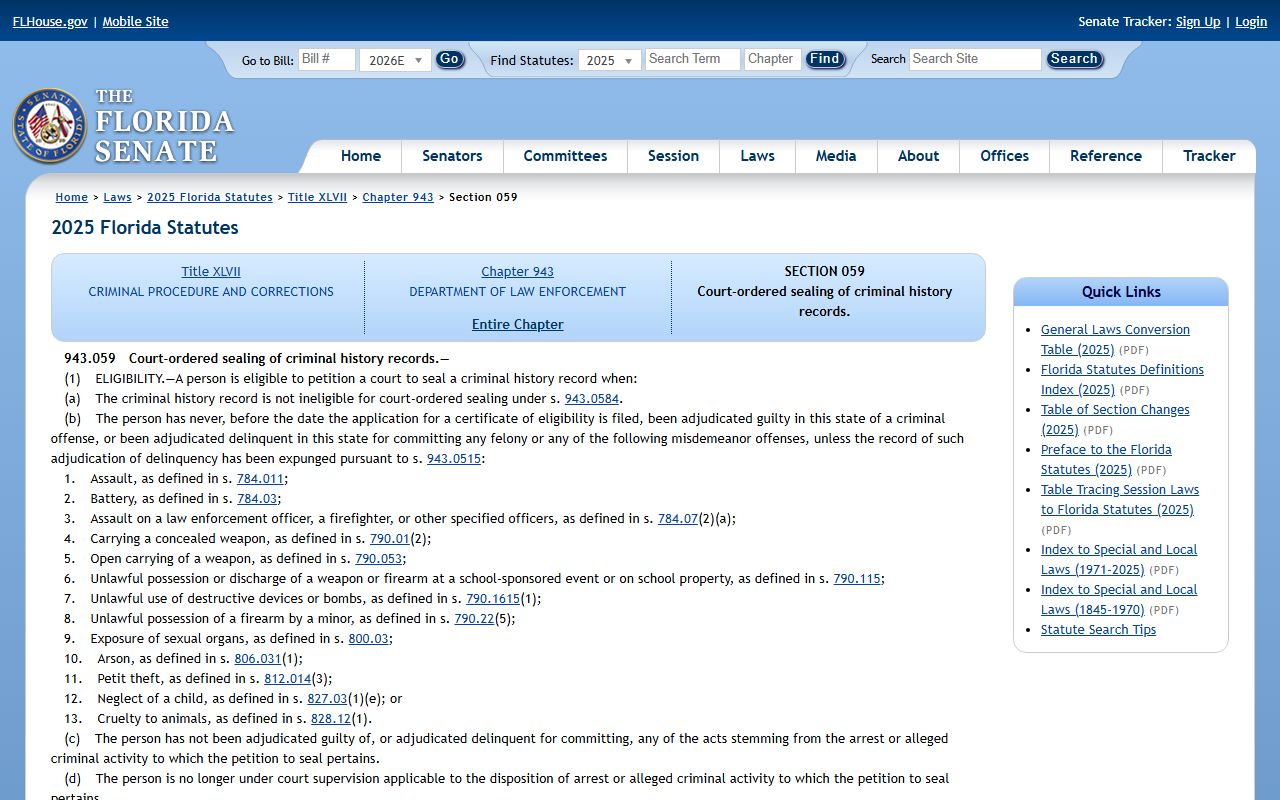
The sealing statute shown above explains which records keep limited agency access even after a court order seals the file.
How to Seal or Expunge a Brevard Criminal Record
The seal or expunge process runs through two offices. The first stop is FDLE, which screens for eligibility. The second is the Brevard County circuit court, which signs the final order. People often hire a lawyer for this, but it can be done pro se when the case is simple. FDLE warns that processing takes more than 12 weeks once a clean application reaches the agency.
- Pull a copy of the case file from BECA or the Clerk so you have the case number, charge text, and final disposition.
- Get a certified disposition from the Brevard County Clerk of the Circuit Court at $2.00 per certification plus the per-page copy fee.
- Fill out the FDLE Application for Certificate of Eligibility and add a fingerprint card from the sheriff or a local agency.
- Mail the form, fee, certified disposition, and prints to FDLE in Tallahassee. Wait for the Certificate of Eligibility to come back.
- File a petition to seal or expunge in the Brevard circuit court, with the certificate, a sworn affidavit, and a proposed order.
- Serve the State Attorney with the petition. Attend any hearing the court sets.
- After the judge signs the order, send certified copies to FDLE, BCSO, and any agency that holds the file.
The screenshot below is from F.S. 943.0585, the expunction statute that drives the FDLE Certificate of Eligibility step. Open F.S. 943.0585 on the Florida Senate site.
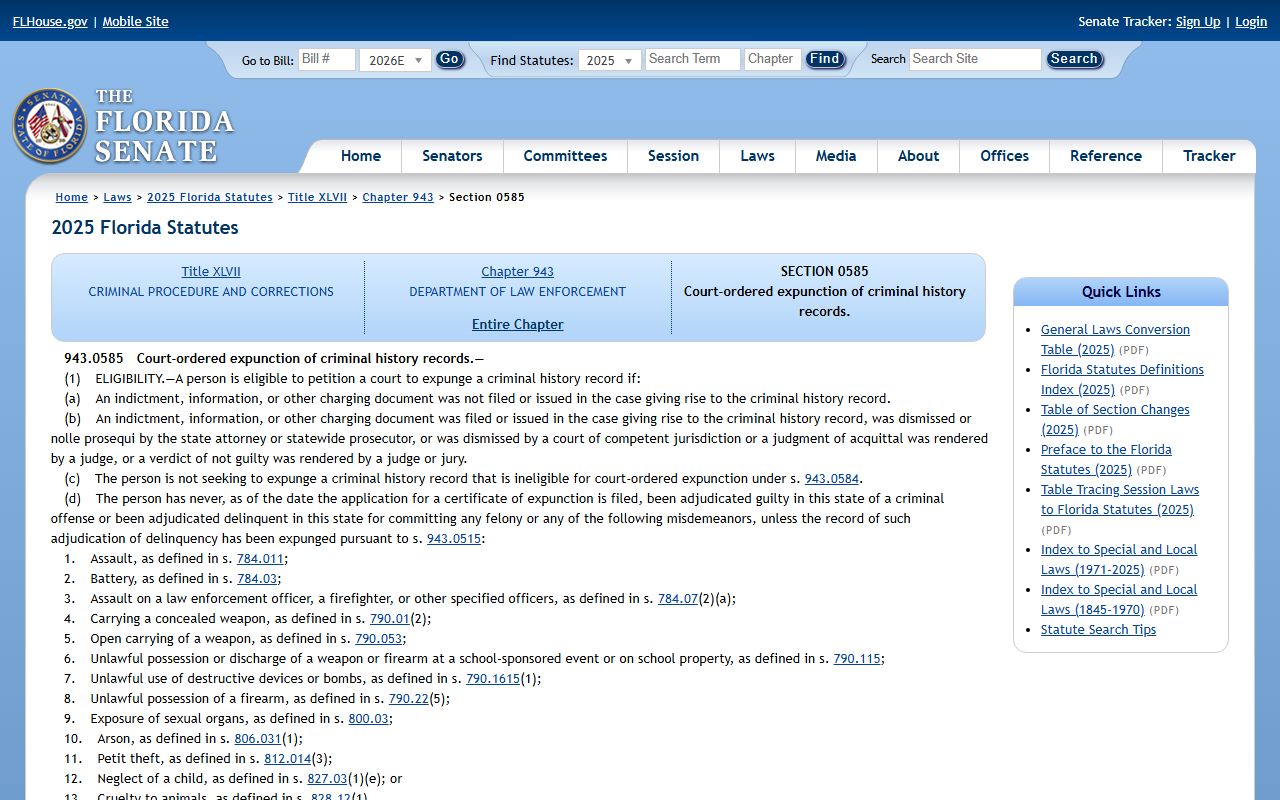
That statute page lists the full list of charges that can never be sealed or expunged, even if every other eligibility test is met. For the full FDLE process flow, see the official FDLE seal and expunge FAQ.
Juvenile Brevard County Criminal Records
Juvenile cases are not handled the same way as adult cases. Florida treats most juvenile justice records as confidential under F.S. 985.04. The public BECA search blocks most juvenile case data, and BCSO does not list juvenile bookings on its public roster. The State Attorney and the court still keep the file. Limited agency access stays in place for law enforcement, schools in some cases, and the child or parent.
Some juvenile records auto-expunge under F.S. 943.0515. FDLE may purge the state file at age 21 for most juvenile records, or at age 26 when the person was committed to a serious or habitual juvenile offender program. The court file held by the Clerk may stay longer, but public access is still tight. A parent or guardian who needs a juvenile record for school, military, or a job can ask the Clerk for a sealed-record letter or work with the juvenile court division.
Note: Juvenile records that include adult co-defendants may still appear in the adult case file under the adult's name.
The Public Defender for Brevard County
People who cannot afford a lawyer in a Brevard County criminal case can ask for the Public Defender. The Public Defender for the 18th Judicial Circuit covers Brevard and Seminole counties. Blaise Trettis has held the office since 2012. A defendant who cannot post bail sees a judge within 24 hours of arrest. The court runs a financial inquiry at first appearance and appoints the office when the test is met.
Public Defender, 18th Judicial Circuit
Blaise Trettis, Public Defender
Serves Brevard and Seminole counties
Application fee: $50.00 to Clerk within 7 days of appointment
Web: 18thjudicialcircuitpublicdefender.com
The Public Defender does not take civil cases, family law, or traffic infractions. For free civil help, Brevard County Legal Aid covers housing, family, and consumer issues. For a paid criminal defense attorney, the Florida Bar Lawyer Referral Service is at (800) 342-8011. For deeper questions about charging documents and case flow, see the FAQ.
Warrants and Capias in Brevard County Criminal Records
A warrant or capias often shows up in the middle of a criminal docket. An arrest warrant is signed by a judge based on probable cause. A bench warrant is issued when a person misses court or breaks an order. In Florida, the word capias often covers the arrest order issued after a missed court date. A search warrant lets law enforcement search a place, but it may be sealed before it is served. Probation violation warrants come up in cases where a person on supervision is alleged to have broken the terms.
BCSO does not host a single Brevard-only warrant search page. It links out to the FDLE Wanted Persons Search and to its own offender alerts site. To check whether a Brevard case has an active warrant tied to it, run a BECA search by name and look for capias or warrant entries in the docket. For a full walkthrough of warrant types and how to clear an outstanding warrant, see Brevard County warrant records. For related case files like infractions and DUI, see traffic court records. For the underlying court that handles felony cases, see Brevard Circuit Court, while misdemeanor cases route through Brevard County Court and certified copies come from the Clerk of Court.
Note: Always confirm any warrant hit with the originating agency before you act on it, since database lag and clerical errors can leave old warrants showing in public tools.