
The Eighteenth Judicial Circuit and Brevard County
The Brevard County Circuit Court is part of the Eighteenth Judicial Circuit of Florida. The circuit covers two counties: Brevard and Seminole. Each county keeps its own case files and its own clerk records. The circuit site at flcourts18.org lists the bench, the divisions, and judicial assistants.
The Eighteenth Judicial Circuit has 43 judges. That breaks down to 26 circuit court judges and 17 county court judges across both counties. Some sit in Brevard, some sit in Seminole, and some hear cases at more than one site. The chief judge sets the rotation. People searching Brevard County Circuit Court records should use Brevard's clerk tools, not Seminole's, since the file stays with the filing county.
Florida Court Structure and Where Circuit Court Fits
Florida runs four court layers. At the top is the Supreme Court of Florida. Below that sit the District Courts of Appeal. Then come the Circuit Courts, the trial courts of general jurisdiction. At the base sit the County Courts. The Brevard County Circuit Court sits on the third tier from the top and acts as the main trial bench for serious matters.
The chart from the Supreme Court of Florida shows how a case moves up the system. Appeals usually go to a District Court of Appeal, and only some cases get a second look from the high court. The chart is published at supremecourt.flcourts.gov, and the state courts system keeps a circuit-court overview at flcourts.gov.
The image below captures the layout in one frame, per supremecourt.flcourts.gov.
The chart shows that the Brevard County Circuit Court is not the top court and is not the bottom court. It is the trial bench where most felony, family, and probate work is done.
What the Brevard Circuit Court Handles
The Brevard County Circuit Court is a court of general jurisdiction. It hears all felony cases. It hears divorce, paternity, child support, and time-sharing. It hears probate, including wills, estates, and guardianship. It hears juvenile delinquency and dependency. And it hears large civil cases above the county court money limit.
Injunctions also go to circuit court. That covers domestic violence, dating violence, repeat violence, sexual violence, stalking, and exploitation of a vulnerable adult. A Brevard County Circuit Court file can hold court orders, hearing notices, motions, and the final judgment.
Small claims, county civil up to the statutory limit, misdemeanors, and most traffic go to the Brevard County Court. For those, see the county court page. For arrest data, see criminal records. For estate filings, see probate records.
Brevard Circuit Court vs Brevard County Court
Florida runs two trial courts at the local level. The circuit court is the higher of the two. The county court is the lower. People often mix the two up because both sit in the same buildings and use the same clerk. The split matters for filing, for fees, and for where an appeal goes. The table below pulls the main points side by side.
| Item | Brevard County Circuit Court | Brevard County Court |
|---|---|---|
| Tier | Trial court of general jurisdiction | Lower trial court |
| Criminal Cases | All felonies | Misdemeanors and criminal traffic |
| Civil Cases | Major civil above the county court limit | Small claims and county civil up to the statutory cap |
| Family / Probate | Divorce, paternity, probate, guardianship, juvenile | Not handled here |
| Traffic | Felony traffic only (such as DUI manslaughter) | Civil traffic infractions and criminal traffic |
| Appeals From | Go to the Fifth District Court of Appeal | Go to the Circuit Court in most case types |
Higher stakes, more time, and a higher appeal court for the circuit branch. Lower stakes and a faster docket for the county branch. Both run out of the same courthouses.
Brevard County Courthouses
The Brevard County Circuit Court holds court at three main sites. Court business is split because the county is long and narrow. The chief judge assigns case types and divisions to each site. The Eighteenth Judicial Circuit publishes the list of locations at flcourts18.org/locations.
| Courthouse | Address | Phone |
|---|---|---|
| Harry T. and Harriette V. Moore Justice Center | 2825 Judge Fran Jamieson Way, Viera, FL 32940-8006 | (321) 633-2171 |
| Melbourne Courthouse | 51 Nieman Ave, Melbourne, FL 32901 | (321) 633-2171 |
| Titusville Historic Courthouse | 506 S. Palm Ave, Titusville, FL 32796 | (321) 633-2171 |
The Moore Justice Center in Viera is the central site. Court administration sits there. Melbourne serves south Brevard. The Titusville Historic Courthouse, also called the Vassar B. Carlton Historic Titusville Courthouse, serves the north end. Anyone with a hearing should check the notice for the right address.
Court Administration and Brevard Circuit Court Judges
Court administration runs out of the Moore Justice Center in Viera. The main phone is (321) 633-2171. Business hours run Monday through Thursday 8:00 AM to 5:00 PM, and Friday 8:00 AM to 4:30 PM.
Brevard Court Administration
Harry T. and Harriette V. Moore Justice Center
2825 Judge Fran Jamieson Way
Viera, FL 32940-8006
(321) 633-2171
Mon-Thu 8:00 AM - 5:00 PM
Fri 8:00 AM - 4:30 PM
For a full list of Brevard County Circuit Court judges, their divisions, judicial assistants, phone lines, and case-type designations, the Eighteenth Judicial Circuit keeps the judicial directory at flcourts18.org/directory. The directory is updated as judges rotate divisions. Case parties should always check the directory before mailing a courtesy copy because judge assignments shift each year.
How a Case Moves Through Brevard Circuit Court
A felony case follows a clear path from arrest to final judgment. Most files take months. Some take years. The steps below show the standard route in the Brevard County Circuit Court. Civil cases skip the arrest and first appearance and start at the filing of a complaint or petition, but the rest of the flow is close.
- Filing. The case enters when the State Attorney files an information or indictment, or when a civil party files a complaint or petition with the clerk.
- First Appearance. A defendant in custody sees a judge within 24 hours. The judge sets bond and reviews probable cause.
- Arraignment. The defendant is told the charges and enters a plea of not guilty, guilty, or no contest.
- Pretrial. Discovery, depositions, motions to suppress, plea offers, and pretrial hearings happen here. Most cases end at this stage.
- Trial. A jury or a judge hears proof. The jury or judge returns a verdict.
- Judgment and Sentence. The court signs the final judgment. In a criminal case, the judge sets the sentence. In a civil case, the court enters a judgment for one side.
- Appeal. The losing party may appeal to the District Court of Appeal within 30 days of the final order.
This flow is a guide, not a strict track. Family cases add mediation. Juvenile cases add adjudicatory hearings. Probate cases add inventory and accounting steps. The clerk's docket shows the path each file actually took. See court dockets for how to read the entries.
Appeals From Brevard Circuit Court
Most appeals from the Brevard County Circuit Court go to a Florida District Court of Appeal. Florida has six DCAs. Brevard sits in the territory of the Fifth District Court of Appeal. The Fifth DCA hears civil, criminal, family, probate, and juvenile appeals out of the Eighteenth Judicial Circuit. A few writ-type matters go straight to the Supreme Court of Florida, but the DCA is the normal next stop.
Older guides sometimes say a party can appeal a Brevard County Circuit Court order to the circuit court. That is not right for circuit-level rulings. The circuit court hears appeals from county court in some case types, but appeals from a circuit judge's final order go up to the DCA. The Supreme Court of Florida may take further review in a narrow set of cases, such as those that pass on the validity of a state statute or that conflict with another DCA. The chart at supremecourt.flcourts.gov sets the path out in one page.
Appeal deadlines are short. A notice of appeal must usually be filed within 30 days of the final order. Miss the deadline and the case is over. People who plan to appeal a Brevard County Circuit Court ruling should talk to counsel right away or look at the self-help links below.
Specialty Courts in Brevard Circuit
The Brevard County Circuit Court runs problem-solving courts as an alternative to traditional prosecution in some cases. The best-documented program is the Veterans Treatment Court. The Eighteenth Judicial Circuit's program page is at flcourts18.org/veterans-treatment-court. The program helps men and women who served in the armed forces, who served as Department of Defense contractors, or who were former military members of foreign allied countries. The path is treatment-focused rather than punishment-focused.
An image of the official Veterans Treatment Court page shows the program criteria and the Brevard contact, per flcourts18.org/veterans-treatment-court.
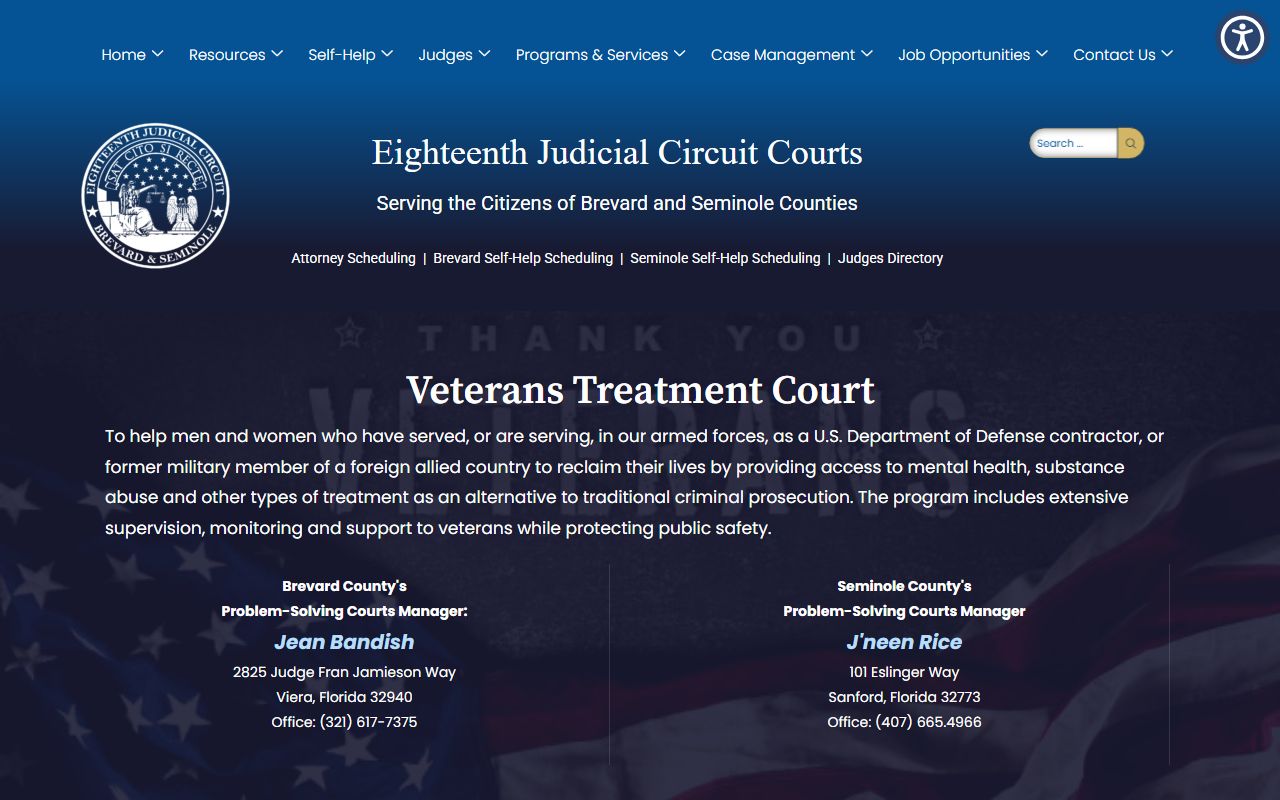
Eligibility requires military service or DoD contractor service, plus a substance abuse, mental health, or traumatic brain injury condition tied to that service. Entry depends on input from the State Attorney's Office, the arresting agency, the Veterans Treatment Court judge, the prior criminal history, the nature of the crime, the service record, and the likelihood of success. Some offenses may be eligible only with State Attorney and law-enforcement agreement.
Problem-Solving Courts - Brevard
Jean Bandish, Problem-Solving Courts Manager
Moore Justice Center, 2nd Floor
2825 Judge Fran Jamieson Way
Viera, FL 32940
(321) 617-7375
Jean.Bandish@flcourts18.org
Note: Veterans Treatment Court is the only Brevard specialty docket fully documented in the circuit's published pages; other problem-solving dockets may run under chief judge order without a public landing page.
How to Search Brevard Circuit Court Records
Most Brevard County Circuit Court records sit in BECA, the Brevard Electronic Court Application. BECA is the public case search tool kept by the Clerk of the Circuit Court & Comptroller. It returns case status, party names, filings, hearing dates, and docket entries. Online results are not certified copies. For a stamped copy, the clerk's office handles the request in person, by mail, or by phone.
- Open the Clerk Case Search page on the Brevard clerk site.
- Pick the BECA General Public Court Records Search route, or the Subscriber route if a subscriber agreement is on file.
- Read the BECA splash disclaimer. Choose Accept, then click Submit.
- Pick General Public Court Records Search after the disclaimer.
- Search by case number, party name, or citation.
- Open the case to see filings, hearing dates, and judges.
- For a certified copy, place the order through the Research and Copy Request Center.
For more on what each record type contains and how to read it, see court records. For docket details, see court dockets. For arrest data tied to a criminal case, the Brevard Sheriff's Office runs its own arrest inquiry page at brevardsheriff.com/bookings; that page links to the official BCSO inmate search.
An image of the BCSO Arrest Inquiry page shows the entry point that ties an arrest to the court case that follows, per brevardsheriff.com/bookings.
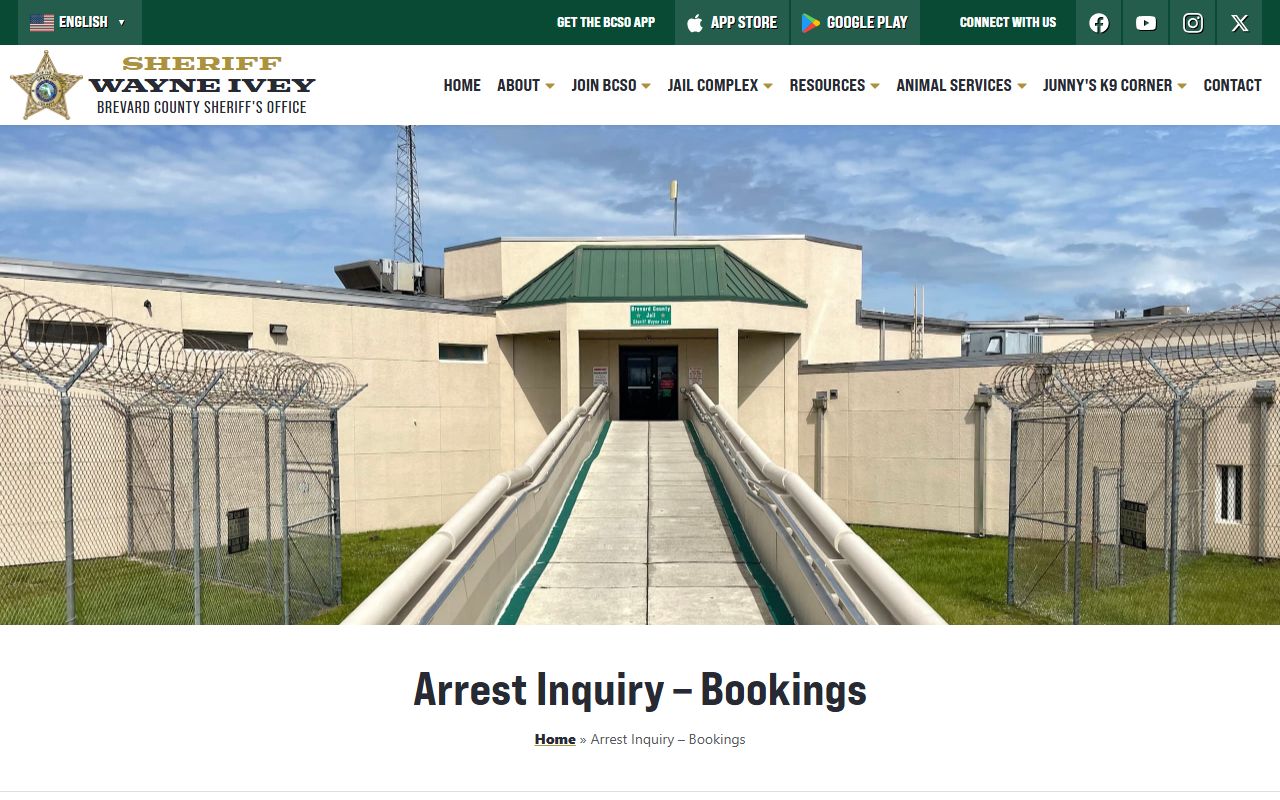
The arrest inquiry page is a useful first stop because it links the booking event to the criminal case that the State Attorney later files in the Brevard County Circuit Court or county court.
Self-Help and Pro Se in Brevard Circuit
The Eighteenth Judicial Circuit runs a self-help page for people who go to court without a lawyer. It is at flcourts18.org/self-help-represent-yourself-pro-se. The page covers small claims paths, landlord-tenant issues, simple family law, and basic probate. It also covers ADA access, interpreter access under F.S. 90.606 and Rule 2.560 of the Florida Rules of General Practice and Judicial Administration, and other access tools for self-represented parties.
Self-help is not legal advice. The staff at the courthouse cannot tell a party what to file, what to say in court, or how a case will turn out. Staff can hand out forms, point to the right window, and explain the process. For full advice, a person needs a lawyer or a legal aid organization. The clerk also runs a pro se appointment program for family law at the Viera and Melbourne sites; see clerk of court for that path.
Free or low-cost help in Brevard runs through Brevard County Legal Aid. The group keeps an intake site and a referral page. For more on access to the courts and rules on confidential filings, see court records and FAQ.
Federal Court Distinction
The Brevard County Circuit Court is a state court. It does not hear federal cases. Federal cases out of Brevard go to the U.S. District Court for the Middle District of Florida. That court's site is at flmd.uscourts.gov. The Middle District handles federal crimes, federal civil cases, civil rights claims, Social Security appeals, prisoner habeas matters, and federal agency cases.
Federal appeals from the Middle District go to the U.S. Court of Appeals for the Eleventh Circuit at ca11.uscourts.gov. Federal records are not in BECA. They sit in PACER, the federal records system, at pacer.uscourts.gov. PACER charges a per-page fee for most documents.
A simple rule helps: a Brevard arrest by a city police officer, a deputy, or a state trooper most likely lands in the Brevard County Circuit Court or county court. A Brevard arrest by an FBI, DEA, or other federal agent most likely lands in the Middle District. Either way, the case file goes where the charging agency files it.