
What Brevard County Court Handles
Florida runs a two-tier trial court system. The circuit court takes the big stuff: felonies, family law, probate, and major civil suits. The county court takes the smaller stuff. Brevard County Court handles misdemeanors, county civil cases under the statutory cap, small claims, civil traffic infractions, and criminal traffic cases like DUI, driving while license suspended, and reckless driving.
Most people who use Brevard County Court are not lawyers. They show up for a speeding ticket, a small claims dispute, a security deposit fight, or a minor criminal charge. The cases move fast. The forms are shorter. The fees are lower. The court still keeps a full record of every filing, hearing, and order. Files live with the Clerk and show up in the same online search tool that holds circuit files.
The Florida Courts page on circuit trial courts sets out the full lineup of trial courts in Florida and shows where the county court sits.
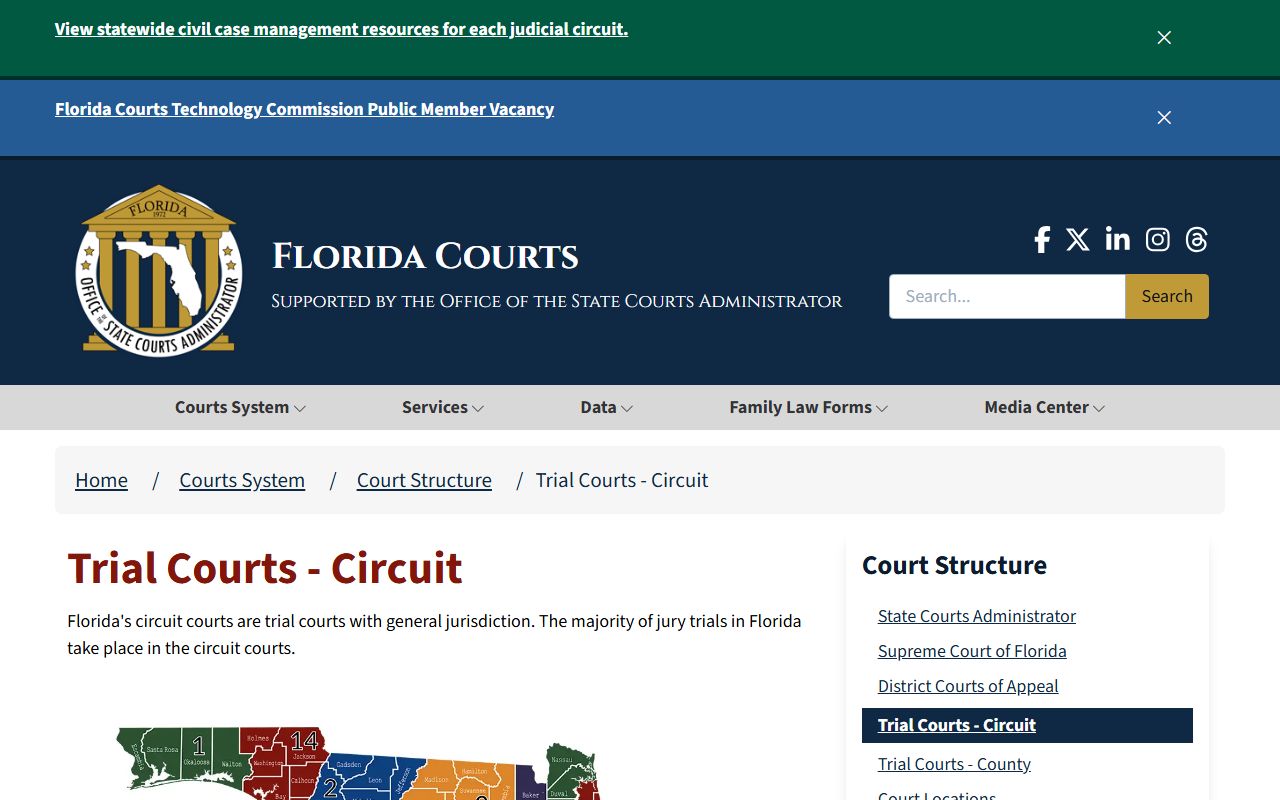
The page maps where county courts fit under the circuit courts and the appellate level.
Brevard County Court vs Circuit Court
The split between Brevard County Court and the circuit court comes down to four things: case type, money limits, how serious a crime is, and where appeals go. The table below lines up the two side by side so the boundary is clear.
| Item | Brevard County Court | Circuit Court (18th Circuit) |
|---|---|---|
| Civil case types | Small claims, county civil, landlord-tenant, replevin, some contract suits | Major civil, foreclosure, contract claims above the cap, equity |
| Monetary limit | County civil up to the statutory cap set by Florida law for county court jurisdiction | Civil cases above the county court cap |
| Criminal cases | Misdemeanors, criminal traffic (DUI, DWLS, reckless driving) | Felonies |
| Family / probate | None | Divorce, paternity, child support, probate, guardianship, juvenile |
| Traffic | Civil traffic infractions, criminal traffic | Felony traffic cases |
| Appeal path | Routed up under current Florida appellate rules; do not rely on outdated "appeal to circuit" shortcuts | District Court of Appeal review for most matters |
For the higher court side of the system, see the circuit court page. For the records that flow out of both, see Brevard court records and the daily court dockets.
Where Brevard County Court Sits
Brevard runs north to south for about 72 miles, so the court keeps three main courthouse sites instead of one big complex. County court divisions sit in all three. The Moore Justice Center in Viera is the main administrative anchor. The Melbourne Courthouse covers south and central Brevard. The historic Titusville courthouse covers the north end of the county and shares space with the Clerk's main administrative office.
| Courthouse | Address | Phone |
|---|---|---|
| Harry T. and Harriette V. Moore Justice Center | 2825 Judge Fran Jamieson Way, Viera, FL 32940-8006 | (321) 633-2171 |
| Melbourne Courthouse | 51 Nieman Ave, Melbourne, FL 32901 | (321) 633-2171 |
| Titusville Historic Courthouse | 506 S. Palm Ave, Titusville, FL 32796 | (321) 633-2171 |
Court business hours across the circuit are Monday through Thursday 8:00 AM to 5:00 PM and Friday 8:00 AM to 4:30 PM. Plan ahead for security screening on the way in.
Brevard County Court Judges
The Eighteenth Judicial Circuit covers two counties: Brevard and Seminole. The full bench has 43 judges. Of those, 26 are circuit judges and 17 are county court judges, split between the two counties. Brevard's share of county judges hears the misdemeanor, county civil, small claims, and traffic dockets at the three courthouses.
The official judicial directory at flcourts18.org/directory lists each judge, the division they sit in, the judicial assistant, and a contact phone. Use the directory before a hearing to confirm the right judge and the right division.
Judges rotate between divisions on a schedule set by the chief judge. A judge who took a small claims docket last year may take a misdemeanor docket this year. Case captions stay tied to the case number, not the judge, so a docket lookup is the safest way to see who is hearing a given case today.
How to Search Brevard County Court Records
The Clerk runs one online portal for both county court and circuit court files: BECA, the Brevard Electronic Court Application. BECA replaced the old eFACTS system in 2018. It is free for general public use. Online results are informational, not certified. The full Brevard court records page walks through BECA in depth; the short version is below.
- Open the Clerk's case search hub and pick the BECA general public option.
- Read the disclaimer page, pick "Accept," and press Submit.
- Choose General Public Court Records Search.
- Enter a case number, party name, or citation number. County court case types include CC for county civil, MM for misdemeanor, SC for small claims, TR for civil traffic, and CT for criminal traffic.
- Open the case from the result list to see filings, hearings, and disposition.
- For a certified copy, route the order through the Clerk's public records request page instead of relying on the online view.
For traffic-only lookups, the Brevard traffic court records page covers citation number searches, fines, and the difference between a court traffic record and a state driver record.
BECA cites Florida Rule 2.420, Rule 2.525, Chapter 119 of the Florida Statutes, and Florida Supreme Court Administrative Order AOSC14-19 as its legal basis. Spelling counts. Bulk scraping is blocked.
Misdemeanor Cases in Brevard County Court
Misdemeanors are the criminal cases that fall under the felony line. Most petit theft, simple battery, trespass, disorderly conduct, possession of small amounts of marijuana, and DUI cases land in Brevard County Court. The state files charges by an information drawn up by the Office of the State Attorney for the Eighteenth Circuit. The accused person is then booked, given a first appearance hearing, and assigned a bond or release condition.
After first appearance, the case moves to arraignment. The defendant enters a plea: guilty, not guilty, or no contest. Many county court misdemeanors end in a plea deal at arraignment or pretrial. If the case goes to trial, the jury has six members under Florida law. Sentences can include jail time up to one year, probation, fines, community service, a public defender fee, and conditions like substance abuse treatment.
Records for a misdemeanor file show the charge, the statute number, the bond amount, the plea, the disposition, and any sentence. For the wider arrest record set, see Brevard criminal records. For the booking side, see the BCSO inmate roster linked from the criminal records page.
Withhold of adjudication is common for first-time misdemeanors. The judge can decline to formally adjudicate the person guilty even after a plea or finding of guilt. That status matters for later sealing or expunction eligibility under Florida law.
County Civil and Small Claims in Brevard County
County civil covers money disputes up to the cap set by Florida law for county court jurisdiction. Small claims is a simpler track inside county civil for the lowest-dollar disputes. The small claims process uses simplified rules: a short pretrial conference, mandatory mediation in many cases, and a quick trial date. Many small claims litigants are pro se, meaning they handle the case without a lawyer.
Common county civil and small claims cases in Brevard include security deposit disputes, evictions, broken contracts, unpaid bills, auto repair disputes, dog bites, and credit card collections. Landlord-tenant cases move fast under Florida statute. The tenant has only five business days to answer an eviction complaint and may have to post rent into the court registry to keep the case alive.
Filing fees, service costs, and clerk fees apply. The Clerk's main service counter at 400 South Street, Titusville, takes filings in person, and electronic filing goes through the statewide e-filing portal. For pro se help, see the self-help section below and the Clerk's pro se appointment program for family law.
Eviction judgments, money judgments, and replevin orders from Brevard County Court can be recorded as liens in the Clerk's official records index, where lookups go back to January 1, 1981.
Traffic Infractions and Criminal Traffic
Traffic is the biggest single workload for Brevard County Court. Civil traffic infractions, like a speeding ticket or a stop sign violation, are payable to the Clerk and do not usually require a court appearance. Criminal traffic is different. DUI, driving while license suspended or revoked with knowledge, reckless driving, and leaving the scene with damage all require a mandatory court appearance and follow the same path as a misdemeanor.
Drivers have 30 days from the date of the citation to pay, elect basic driver improvement school where allowed, or request a court hearing. Commercial driver license holders cannot elect school. Speeding 30 mph or more over the limit is also school-ineligible and requires a court date. The Clerk takes payments by mail, online, Western Union, Amscot, or in person.
The full walkthrough for citation lookup, payment, contesting a ticket, and the court traffic record vs state driver record split lives on the traffic court records page. DUI cases overlap with the criminal side and show up in the criminal records file as well.
Appeals from Brevard County Court
The appeal path from a county court ruling in Florida has shifted in recent years. The older rule sent most county court appeals up to the circuit court. Florida changed that framework, and parts of the appellate map now route certain county court matters to a District Court of Appeal instead. Do not rely on outdated "appeal to circuit court" shortcuts without checking the current rule and the specific case type.
The District Court of Appeal that covers Brevard sits in the appellate map alongside other east-central Florida counties. Each appeal has strict timing rules. Notice of appeal usually has to be filed within 30 days of the order being appealed. Missing that window is fatal in most cases.
People who plan to appeal a small claims, county civil, criminal traffic, or misdemeanor case should consult a lawyer or use the self-help resources below before filing the notice. The Clerk staff cannot give legal advice under Florida law.
Restricted Brevard County Court Records
Not every county court file is open to anyone. Some are sealed, some are confidential by statute, and some are limited to certain user roles in the BECA system. Two Florida statutes do most of the work here, plus Florida Rule of General Practice and Judicial Administration 2.420.
Key statutes for restricted records:
F.S. 985.04 - Juvenile justice records confidentiality. Limits broad public access to juvenile records and protects identifying details for many youth files.
F.S. 119.0714 - Court files, court records, official records. Sets the core privacy framework for court files and lists categories of exempt information like SSNs and bank account data.
The juvenile court itself is a circuit court matter, not county court, but the confidentiality rule still affects misdemeanor cases that involve a young defendant or a juvenile victim. Sealing and expunction are handled under Florida Statutes 943.0585 and 943.059, and a person must first get a Certificate of Eligibility from FDLE before filing the petition.
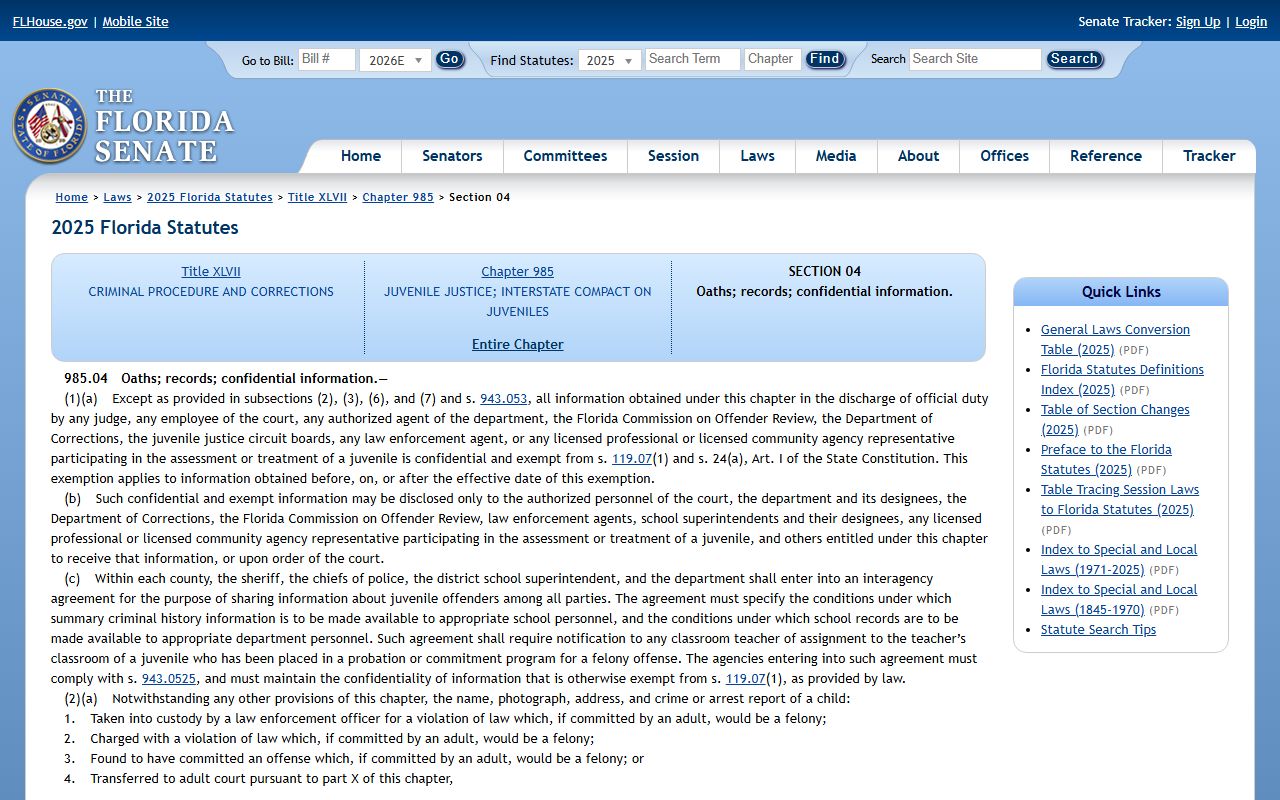
The statute text sets out which juvenile records can be shared, with whom, and under what conditions, which is why young defendants in county court appear in BECA only under tight access rules.
Common Brevard County Court Terms
- Information
- The charging document the prosecutor files in a misdemeanor case. It lists the charge, the statute, and the basic facts.
- Arraignment
- The first formal court date where the charges are read and the defendant enters a plea.
- Plea
- The defendant's answer to the charge: guilty, not guilty, or no contest (nolo contendere).
- Withhold of adjudication
- A Florida disposition where the judge does not formally adjudicate guilt even after a plea, often used for first offenders.
- Civil infraction
- A non-criminal traffic or code violation paid as a fine, with no jail risk and no jury trial.
- Small claims
- A simplified county civil track for low-dollar disputes, designed for parties without lawyers.
- Summons
- The official notice that tells a person they have been sued and must respond by a deadline.
Note: Online BECA results are informational; only Clerk certified copies count as official court records for legal use.
Self-Help, Legal Aid, and Pro Se for Brevard County Court
Most county court litigants represent themselves. The Eighteenth Judicial Circuit keeps a self-help page at flcourts18.org/self-help-represent-yourself-pro-se that covers small claims, landlord-tenant evictions, family law, and probate estate cases. The page also references interpreter access, ADA accommodations, and the limits on what court staff can tell a self-represented party.
For free civil legal help, Brevard County Legal Aid at brevardcountylegalaid.org takes referrals at (321) 631-2500. The group was set up in 1970 by the Brevard County Bar Association and runs on a network of more than 400 volunteer attorneys. Eligibility is based on income. Covered areas include family law, domestic violence, foreclosure, guardianship, landlord-tenant where the tenant is current on rent, consumer cases above the small claims cap, and bankruptcy where debt exceeds $10,000 and more than half is medical bills.
The Clerk also runs a pro se appointment program for family law cases at Viera and Melbourne. Staff are not attorneys and cannot give legal advice under Florida Statute 28.215. For a probate attorney referral, the Clerk points readers to the Florida Bar Lawyer Referral Service at (800) 342-8011. For the broader records and forms hub, see the Clerk of Court page and the FAQ. Probate matters route to the probate records page. Family files like divorce go through marriage and divorce records.
The Clerk's public records request page lays out every channel for asking for a county court record by name, case number, or topic.
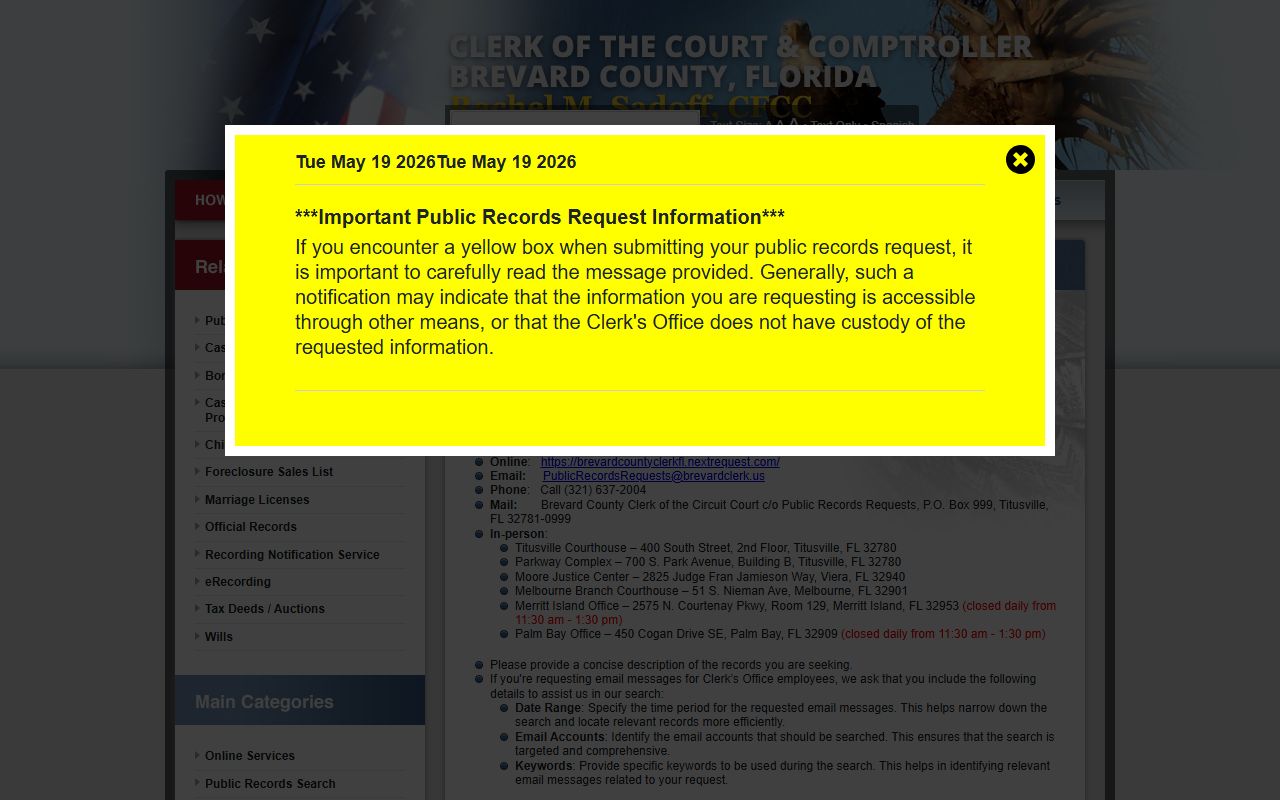
The page lists online NextRequest submission, email, phone, mail, and walk-in options at six Clerk offices across the county, plus copy fees and certification fees that apply to county court files.